

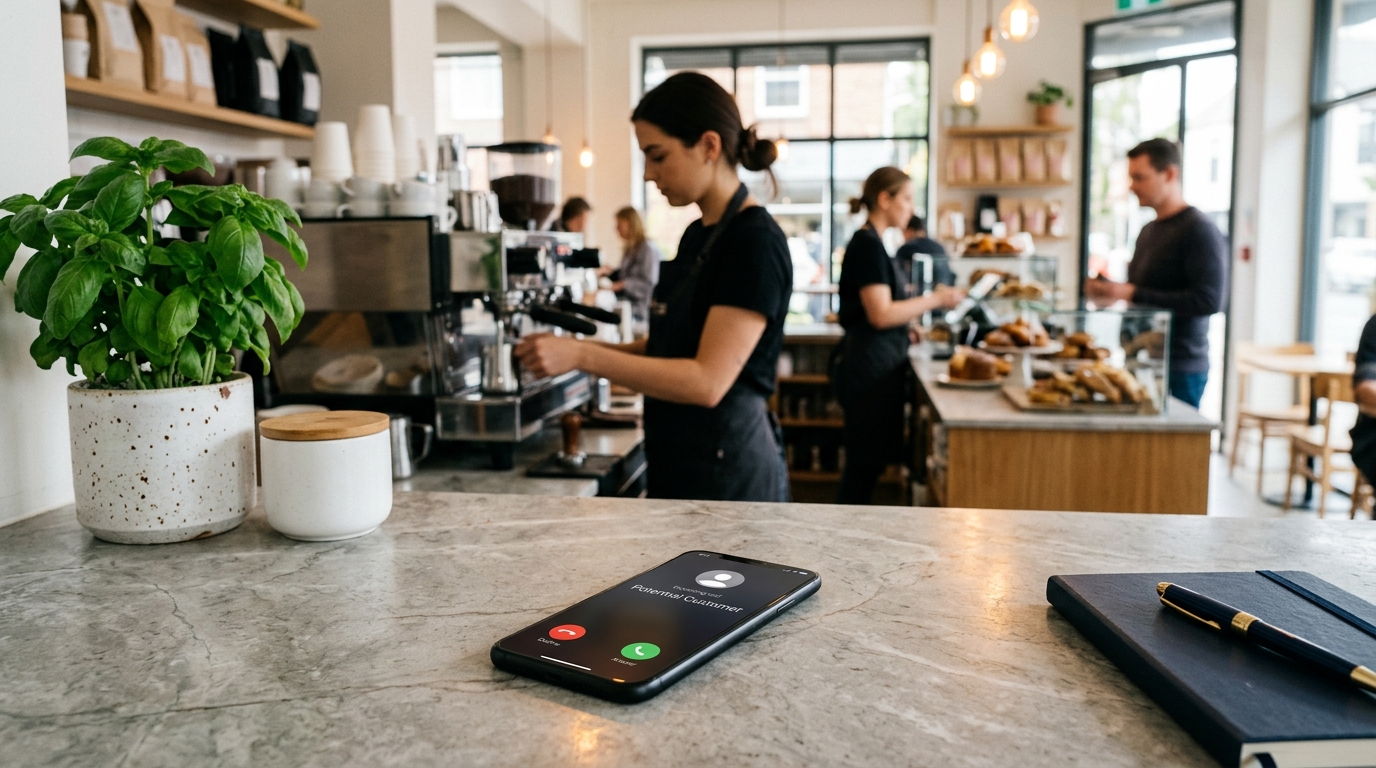
Most business owners know missed calls are frustrating. Fewer know what they are actually worth.
If someone calls because they need a plumber, want to book an appointment or are ready to ask for a quote, the value of that call is not the phone call itself. It is the potential customer behind it. If nobody answers and they call the next business on Google, the opportunity may disappear before you even know it existed.
The useful question is not “How many calls did we miss?” It is “How much potential business sits behind the calls we miss?”
A simple way to estimate the cost
You do not need a complicated model. Start with four numbers: how many genuine new-customer calls you miss, how many of those callers would have been a good fit, how often a qualified enquiry normally becomes a customer, and the average value of a new customer.
For example, if you miss 20 genuine enquiries in a month, half are a good fit, 40% of qualified enquiries normally buy, and an average first job is worth $500, that represents around $2,000 in potential first-job revenue. If customers tend to return, refer others or buy higher-value work later, the longer-term value can be higher.
The point is not to create a perfect forecast. It is to make an invisible problem visible.
Why small businesses miss calls
- Everyone is already serving customers.
- The owner is on the tools, in a meeting or driving.
- Calls arrive after hours or on weekends.
- The person who normally answers is away.
- The team answers the call but follow-up gets lost.
- The caller hangs up rather than leaving a voicemail.
None of those problems mean your team is doing a bad job. They usually mean the business has grown beyond a process that once worked.
What can you do about it?
There is no single right answer. A receptionist, call answering service, better voicemail process, online booking, automated text response or AI receptionist can all be sensible in different businesses.
An AI receptionist can be useful where customers regularly call with predictable needs such as booking, checking availability, asking common questions, requesting a quote or leaving details for the team. It can answer outside normal hours, collect information and hand over when a human is needed.
It is not the right answer for every conversation. Sensitive, complex or high-value discussions may still need a person. Good automation should make it easier for customers to reach the right human, not trap them behind technology.
Start with the leak, not the AI
Before buying anything, look at when calls are being missed, what those callers usually want and what should happen next. Sometimes the answer is an AI receptionist. Sometimes it is a better follow-up process. Sometimes the biggest leak is not the call at all.
Klyse helps Australian businesses find the work and revenue that are slipping through the cracks, then work out the simplest way to fix it.
Quick questions
Can an AI receptionist book appointments? In many businesses, yes, provided it can be connected appropriately to the booking or calendar system.
Can it transfer to a person? Depending on the setup, calls or information can be escalated to the right person when human help is needed.
Should every call be automated? No. The goal is a better customer experience and less unnecessary work, not automation for its own sake.